
A ClickHouse alternative that stays simple at scale
Ingest data, write familiar SQL, and join across your existing systems. Altertable handles storage, compaction, and query compute so your team can focus on using the data as it grows.
Scale with less to manage
Ingest data and query it with familiar SQL. Altertable manages storage, compaction, and compute as your data and usage grow.
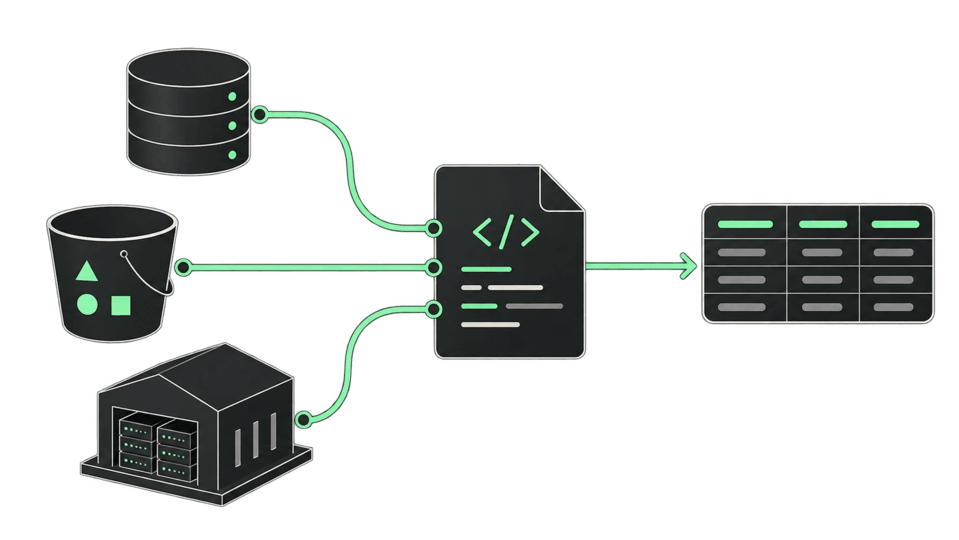
Ingest without managing the engine
Send events or upload files. Altertable manages the path from incoming data to queryable tables, without asking you to coordinate background merges and query workloads.
Use the SQL you know
Write familiar joins, filters, and aggregations with DuckDB SQL. Explore new questions without choosing a table engine or flattening every relationship in advance.
Keep your data in open formats
Store managed tables as open Parquet files in object storage. Your data stays portable as your tools and workloads evolve.
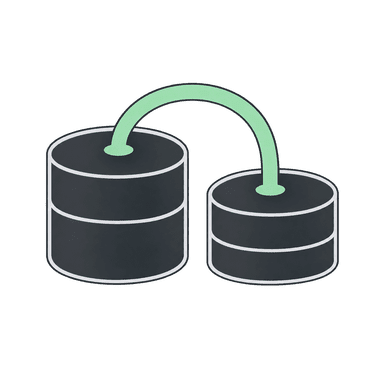
Join data where it lives
Query Postgres, Snowflake, BigQuery, and lakehouse files alongside managed tables. Federation lets you answer questions without copying every source first.
Move at your own pace
Keep ClickHouse running while you connect existing sources and move selected workloads to Altertable.
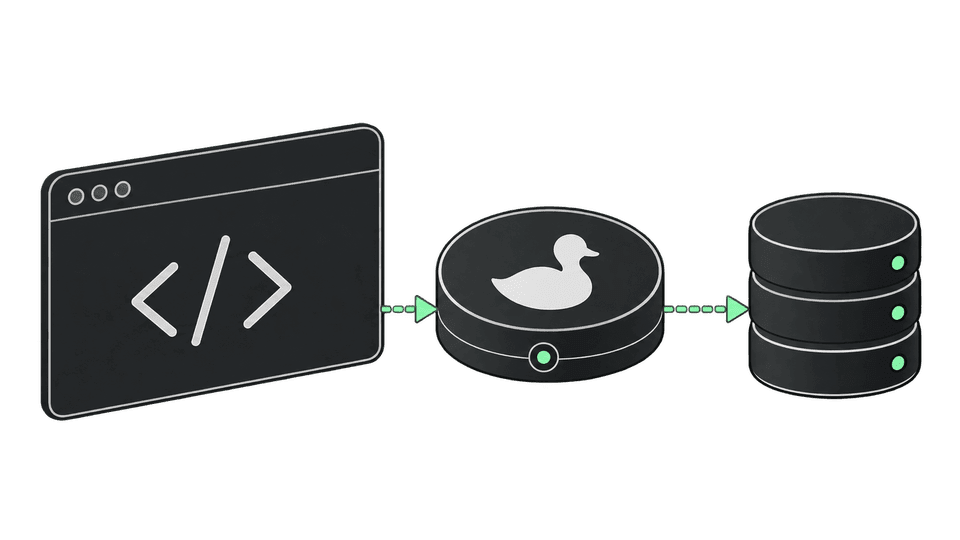
Connect existing sources
Bring operational and warehouse data into one SQL workspace through external catalogs.
Send new data to Altertable
Send new events or files straight to Altertable and query them with SQL. Keep your existing ClickHouse pipelines running.
Migrate selectively
Move proven workloads when the economics and operational fit make sense.
Put the data to work
Connect BI tools, notebooks, applications, and agents to the same data and shared business definitions.
Less tuning. More analysis.
Compare how each platform handles ingestion, SQL, storage, and data across systems.
Day-to-day operations
ClickHouse Cloud: Manages infrastructure, while your team still tunes table design, ordering keys, and ingestion strategy for the workload.Altertable: Manages ingestion, file layout, compaction, caching, and query compute. Scale compute independently of stored data.SQL and data modeling
ClickHouse Cloud: Supports SQL and joins, with engine-specific table definitions and performance choices. Denormalization is recommended for latency-sensitive workloads.Altertable: Use familiar DuckDB SQL and relational joins across tables and sources. Start with your data and questions, without selecting storage engines or merge strategies.Open storage
ClickHouse Cloud: Uses its own native table storage format, with support for reading external open formats.Altertable: Stores managed table data in open Parquet files, and queries existing lakehouse files in place.Data across systems
ClickHouse Cloud: Offers external integrations and lake queries alongside its native analytical tables.Altertable: Makes live federation part of everyday SQL: join databases, warehouses, object storage, and managed tables in one query.Frequently asked questions
How Altertable fits alongside ClickHouse Cloud.
When should I choose Altertable over ClickHouse Cloud?
Choose Altertable when you want analytics to stay simple as data and usage grow: managed ingestion, familiar SQL, open storage, and federation across your existing systems. It is especially useful when your questions change often and your team wants to spend more time on analysis than database tuning.
How does Altertable simplify ingestion and queries?
Send records or files through managed ingestion and query the resulting tables with SQL. Altertable handles file layout, compaction, caching, and query execution, so your team does not have to coordinate background maintenance with analytical workloads. Compute scales independently of storage, and query sizing can be selected automatically within your available capacity.
Do I need to learn another query language?
Altertable uses DuckDB SQL, with familiar SELECTs, joins, filters, and aggregations. You do not need to learn ClickHouse table engines or merge behavior to get started. Existing ClickHouse queries may need syntax changes when moving to DuckDB SQL.
Do I have to ingest every source before I can query it?
No. Connect supported databases, warehouses, and lakehouse files as external catalogs, then join them with managed Altertable tables using SQL. For example, combine product events in Altertable with customer records in Postgres and revenue data in BigQuery.
Do I need to replace ClickHouse all at once?
No. Start with a new workload or a selected dataset while ClickHouse continues serving existing applications. To move ClickHouse data, export it as Parquet and import it into Altertable, then adapt and validate the queries before switching that workload.

Grow your analytics. Simplify your operations.
Bring your data, write familiar SQL, and let Altertable handle the lakehouse.
ClickHouse is a trademark of ClickHouse, Inc. This comparison is not affiliated with or endorsed by ClickHouse.